
In the wake of the FTA between India and the European Union, the United States has described the Europeans as 'very disappointing', saying they were unwilling to join Washington, DC in putting tariffs on New Delhi for its purchases of Russian oil because of this trade deal.
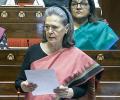
Congress Parliamentary Party chairperson Sonia Gandhi has criticized the Waqf (Amendment) Bill, calling it a 'brazen assault' on the Constitution and part of the BJP's strategy to keep society in a 'permanent state of polarization.' She also spoke out against the One Nation, One Election Bill, calling it a 'subversion of the Constitution.' Gandhi further accused the Modi government of ignoring the women's reservation bill and other demands for reservation, and of 'dragging the country into an abyss' where the Constitution will only exist on paper. She also criticized the government for limiting the speaking time of the Leader of the Opposition in Parliament and for not allowing discussions on important issues like the working of the defense and external affairs ministries and the challenges posed by China on the border.

Water conservationist Rajendra Singh blames corruption and faulty infrastructure for the contaminated water crisis in Indore, which led to multiple deaths. He criticizes the city's reliance on the Narmada River and the lack of responsible water management.

The Lok Sabha witnessed chaotic scenes as opposition members protested the introduction of three draft laws, leading to torn bills, sloganeering, and adjournments.

The liquidity will move into deficit after advance tax payments and GST outflows. It will rebound in October because of government spending.

'Even if it is defeated and the Speaker remains, the Opposition parties that have lost faith in his impartiality will continue to have that feeling.' 'If the Speaker reflects on this and tries to be more neutral, more impartial, more objective in his conduct -- then one can say the resolution had a salutary effect. That would be the best outcome.'

Finance Minister Nirmala Sitharaman on Saturday presented Union Budget 2025-26, envisaging an expenditure of Rs 50,65,345 crore, an increase of 7.4 per cent over the current fiscal.
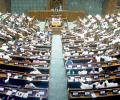
Parliament's approval of the Waqf (Amendment) Bill, a contentious piece of legislation aimed at reforming Waqf bodies, has sparked strong reactions from the opposition, who allege that the bill was "bulldozed" through Parliament. The bill, considered the government's most consequential legislation in its third term, was passed with comfortable majorities in both the Lok Sabha and Rajya Sabha despite opposition claims of a lack of consultation and an intrusion into religious affairs. Other notable bills approved during the session included the Finance Bill, Appropriation Bill, Immigration and Foreigners Bill, and Tribhuvan Sahkari University Bill. The session, which saw high productivity, also witnessed debates on issues such as economic distress, delimitation, and the three-language policy. While the government touted its achievements, the opposition criticized the government's approach and vowed to challenge the Waqf bill in court.

Tamil Nadu Chief Minister and DMK president M K Stalin announced that his party will file a case in the Supreme Court against the Waqf Bill passed in the Lok Sabha. The opposition AIADMK expressed solidarity with the DMK's stance, while the BJP members staged a walkout from the Assembly in protest. The CM argued that the amendment was passed at the behest of a few allies despite opposition from majority parties and that it is an attack on the Constitution and religious harmony. The DMK claims the bill threatens the autonomy of the Waqf Board and the Muslim minority population.
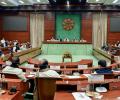
Opposition parties in India are demanding a discussion on the Special Intensive Revision (SIR) of electoral rolls and national security in the upcoming Winter Session of Parliament. They raised concerns about federalism, national security, and the purity of voter lists during an all-party meeting.

The rupee is undervalued as compared to its peers, shows the latest data from the Reserve Bank of India (RBI), even as the local currency keeps hitting new lows.

Retail investors could be hesitant to invest in floating rate savings bonds, as these specific bonds tend to be profitable only in a rising rate environment, according to market participants. The Reserve Bank of India has allowed subscriptions for floating-rate savings bonds, 2020, via retail direct - an online portal that enables individual investors to purchase government securities.

The Lok Sabha, India's lower house of Parliament, will debate the contentious Waqf (Amendment) Bill on Wednesday. The bill has been met with strong opposition from several parties who claim it is unconstitutional. The government, however, insists the bill aims to improve the management of Waqf properties in India by bringing transparency and efficiency.

The rupee breached 90-levels against the greenback for the first time on Wednesday, falling 6 paise to 90.02 in early trade, as banks kept buying US dollars at higher levels and FII outflows continued.

'Grassroots-level corruption, which disrupts the last-mile work, cannot be ignored in your enthusiasm and drive to get going to complete the project.' 'Like it was in MGNREGA, in some states, it is the case with the Jal Jeevan mission.' 'The last minute levels of corruption can ruin the intent of the project itself.' 'When you see that people can game a particular well-intended and well-crafted project, you need to correct that.'
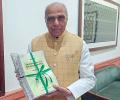
'They want to snatch the land and give it to their friends'
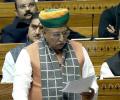
Two bills that lay down the mechanism to hold simultaneous elections were introduced in the Lok Sabha after a fiery debate on Tuesday, with the opposition terming the move 'dictatorial' and Law Minister Arjun Ram Meghwal asserting that the legislation would not tamper with the powers enjoyed by states.

The Indian economy could remain less affected by global trade wars than other countries because the two engines of domestic growth - consumption and investment - are likely to face a limited impact from such headwinds, according to an article on the 'State of the Economy' in the Reserve Bank of India's (RBI's) bulletin, released on Tuesday.
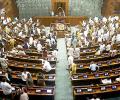
The Monsoon session of Parliament concluded after facing disruptions and protests over the revision of electoral rolls in Bihar. Despite the disruptions, the government managed to pass key legislations.

After effecting two back-to-back 25 basis points rate cuts, Reserve Bank Governor Sanjay Malhotra on Wednesday hinted at another reduction in key policy rate by changing the central bank's monetary stance to 'accomodative' from 'neutral', which may further lower EMIs for consumers.

While the country imposed limits, it also eased and simplified other restriction to attract foreign inflows. This is done to plug record current account deficit.

Yes, the entry of private bankers, particularly with global experience will add value to PSBs, points out Tamal Bandyopadhyay.

The former Bihar Chief Minister was sentenced to five years in prison and slapped a fine of Rs 60 lakh by a special CBI court in Ranchi in connection with the fifth fodder scam case involving embezzlement of over Rs 139 crore by Doranda treasury.

From the Sensex firms, Mahindra & Mahindra, Bajaj Finserv, Tech Mahindra, Power Grid, ITC, Hindustan Unilever, Reliance Industries and Maruti were the biggest laggards. IndusInd Bank, Bharti Airtel and UltraTech Cement were the gainers.

The ties between India and the Maldives came under severe strain since Muizzu, known for his pro-China leanings, took charge of the top office in November.

The introduction of tax deducted at source (TDS) on income from central government securities and state bonds may not lead to a significant effect on retail participation, according to market participants. The Union Budget proposed that starting October 1, 2024, investors may face a 10 per cent TDS on investments in central government securities and state development loans (SDLs). "Last Budget, TDS on interest on securities was reintroduced.
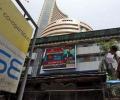
Leading bourses BSE and NSE and money markets will remain closed on Thursday on account of Eid al-Adha also known as Bakrid. Earlier, the holiday was scheduled for June 28. The markets are now open on Wednesday. The change came after the Maharashtra government declared June 29 a public holiday as the festival of Bakrid falls on this day instead of June 28 declared earlier.

The country's total debt, or the total outstanding bonds which are being traded in the market, rose to $2.47 trillion (Rs 205 lakh crore) in the September quarter, according to a report. The total debt amount in the March quarter of the previous fiscal was $2.34 trillion (Rs 200 lakh crore). The central government's debt stood at $1.34 trillion, or Rs 161.1 lakh crore, in the September quarter, up from $1.06 trillion, or Rs 150.4 lakh crore, in the March quarter, Vishal Goenka, co-founder of Indiabonds.com, said, quoting data provided by the Reserve bank of India.

It was a faux pas by Treasury Benches members when they voted against a clause in the Food Security Bill in the Lok Sabha on Monday night, thinking it was a division on an amendment moved by the Leader of the Opposition Sushma Swaraj.

Who else will take on the might of Microsoft, Google, and Amazon if not the Adanis, Ambanis, Birlas, or Tatas?, asks R Jagannathan.
The Reserve Bank of India (RBI) on Monday did a four-day variable rate reverse repo (VRRR) auction to reduce liquidity in the banking system as the overnight money market rates fell below the repo rate, said market participants. The repo rate is 6.50 per cent. Banks parked Rs 18,750 crore at the auction against a notified amount of Rs 50,000 crore at a weighted average rate of 6.49 per cent.

When he didn't respond (Mr Saver has lost count of how many relationship managers he has had in the past few years!), the gentleman landed up at his doorstep and started pleading with him to open fixed deposits with the bank, observes Tamal Bandyopadhyay.

The Reserve Bank of India's (RBI's) record surplus transfer to the government has raised hopes among bond traders that the government might reduce its gross borrowing for the current financial year (2024-25/FY25) by up to Rs 1 trillion. The RBI approved a dividend of Rs 2.11 trillion for the central government for 2023-24, marking an increase of roughly 141 per cent from 2022-23 (FY23). In addition, the contingency risk buffer has been raised to 6.5 per cent from the previous 6 per cent.

"Mr Kalyan Banerjee rose in this House and said sorry. But I will say that we all come to this House with the spirit of contribution to the nation's development...but we also come with a sense of self respect.

Several Bharatiya Janata Party-ruled states in the country, including Gujarat and Assam, have expressed their keenness to follow the Uttarakhand UCC as a model.

Investors need to evaluate how they stack up against other high credit quality fixed-income options before putting money in them.

The Lok Sabha on Wednesday passed three bills to replace the colonial-era criminal laws by voice vote.

Returns of liquid funds are meant only for the short term and don't help investors create wealth over the long term, as equity funds do.
